The Crane in the Snow
A misty, snow-dusted cemetery stretched beneath a cold grey sky. Bare oak trees stood scattered across the grounds like silent witnesses to stories that had already ended. The wind moved low and steady, brushing across rows of weathered stones half-buried in frost.
Bootsteps crunched through frozen earth.
A burly, middle-aged biker walked slowly between the graves. His black beanie was pulled low, his thick grey beard dusted with snow. A worn leather vest clung to his frame, old patches faded with time—names and places that no longer mattered anywhere except here.
He didn’t look like he belonged in a cemetery.
But he didn’t look lost either.
More like something had been waiting for him.
He stopped.
Ahead, near a weathered granite tombstone, stood a small girl.
Seven or eight years old. Quiet. Still. Her blonde hair peeked out from beneath a dark winter coat, and a bright red scarf cut sharply through the muted landscape like a single living color in a dead world.
The biker frowned slightly and stepped closer.
His voice came rough, cautious.
“Kid… you lost?”
She shook her head.
“No.”
He glanced at the tombstone beside her, then back at her again, trying to connect something that didn’t make sense.
“How do you know this place?” he asked. “That name on the stone?”
The girl looked up at him calmly, like she had been waiting for exactly this question.
“My mom,” she said softly. “This is her.”
A pause.
The wind moved through the trees.

The biker’s expression tightened slightly.
“She said you’d come,” the girl added.
That line landed heavier than the cold.
He looked at the grave again.
Then back at her.
And something in his face shifted—just a crack at first. Like a locked door inside him had started to recognize its own key.
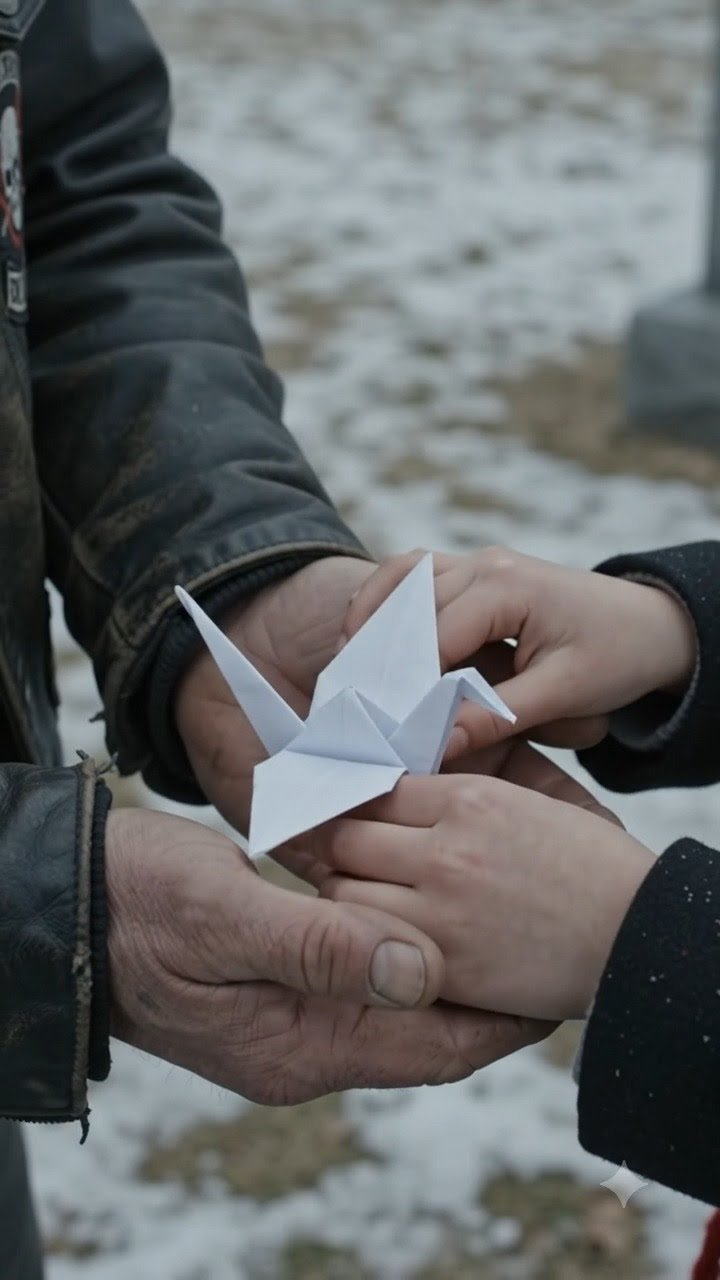
The girl reached into her coat and carefully pulled out a small origami crane, folded from white paper already softened by time.
She stepped closer and gently placed it into his rough, weathered hands.
The biker didn’t move.
Didn’t speak.
Just stared at it.
Fragile. Small. Impossible against the weight of his palms.
“My mom said,” the girl whispered, “love doesn’t stop… even when someone is gone.”
Something inside him broke open.
Not loudly.
Not dramatically.
Just completely.
A breath caught in his throat as his grip tightened slightly around the paper crane, like letting go might erase the moment itself.
His eyes lowered.
And then he finally understood.

A tear slipped down through the edge of his beard, cutting a clean line through the frost on his skin.
He turned slowly toward the tombstone.
Like he was seeing it for the first time.
Like he was seeing everything for the first time.
“I’m sorry,” he whispered—not sure who he was saying it to.
The wind answered instead.
He knelt down in the snow, placing the crane carefully onto the edge of the grave, as if afraid even regret might break it.
Above him, the cemetery stayed silent.
But far overhead, a lone bird crossed the grey sky—small, distant, free.
And for the first time in a long time, the man didn’t feel completely alone inside the silence.
Our Facebook Group
Join Our Group