The Ten-Dollar Decision
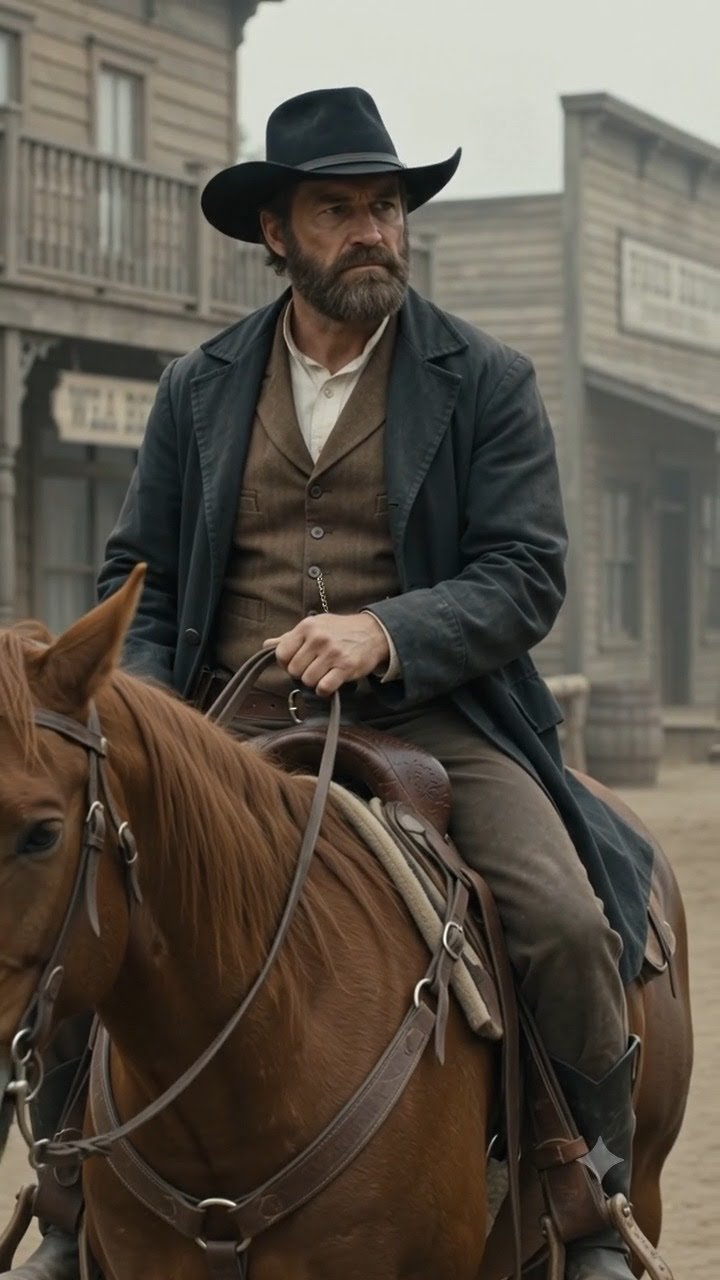
A misty 19th-century Western town lay swallowed beneath a heavy gray sky.
Fog curled between wooden storefronts, softening everything into shadow and silence.
The street felt abandoned—except it wasn’t.
At the center stood a rough wooden platform.
An auctioneer paced back and forth, gesturing too eagerly, voice echoing through the damp air.
“She ain’t much to look at…” he called out, forcing energy into the emptiness. “…but she works sunup to sundown!”
Beside him, a woman stood bound at the wrists with thick rope.
Her grey dress clung to her from dust and fear.
She didn’t speak.
Not yet.
In the distance, townspeople lingered beneath awnings and doorways, watching without stepping forward.
As if presence alone was safer than action.
Off to the side of the street—
a bearded man sat mounted on a brown horse.
Black hat low.
Still as stone.
Like he had been there long before the auction began.
The auctioneer kept talking, voice rising now, desperate to force attention.
Then—
a single voice cut through everything.

“Ten dollars.”
The street froze.
Even the wind seemed unsure whether to continue.
The auctioneer stopped mid-gesture, blinking as if he hadn’t heard correctly.
For the first time—
he had no follow-up words ready.
On the platform, the woman slowly lifted her head.
Dust clung to her lashes.
Her eyes searched through the fog until they found the man on horseback.
Something inside her shifted.
Fear didn’t leave—but confusion broke through it.
“Why?” she whispered.
Barely a sound.
The man didn’t answer.
Didn’t shift.
Didn’t justify.
He simply remained there, as if the decision had already been made long before anyone else was invited into it.
The silence stretched longer than comfort allowed.
And in that stretch—
the town understood, without anyone saying it aloud:

this wasn’t a transaction waiting for approval.
It was a fate already in motion.
Our Facebook Group
Join Our Group