The Lesson That Couldn’t Be Bought
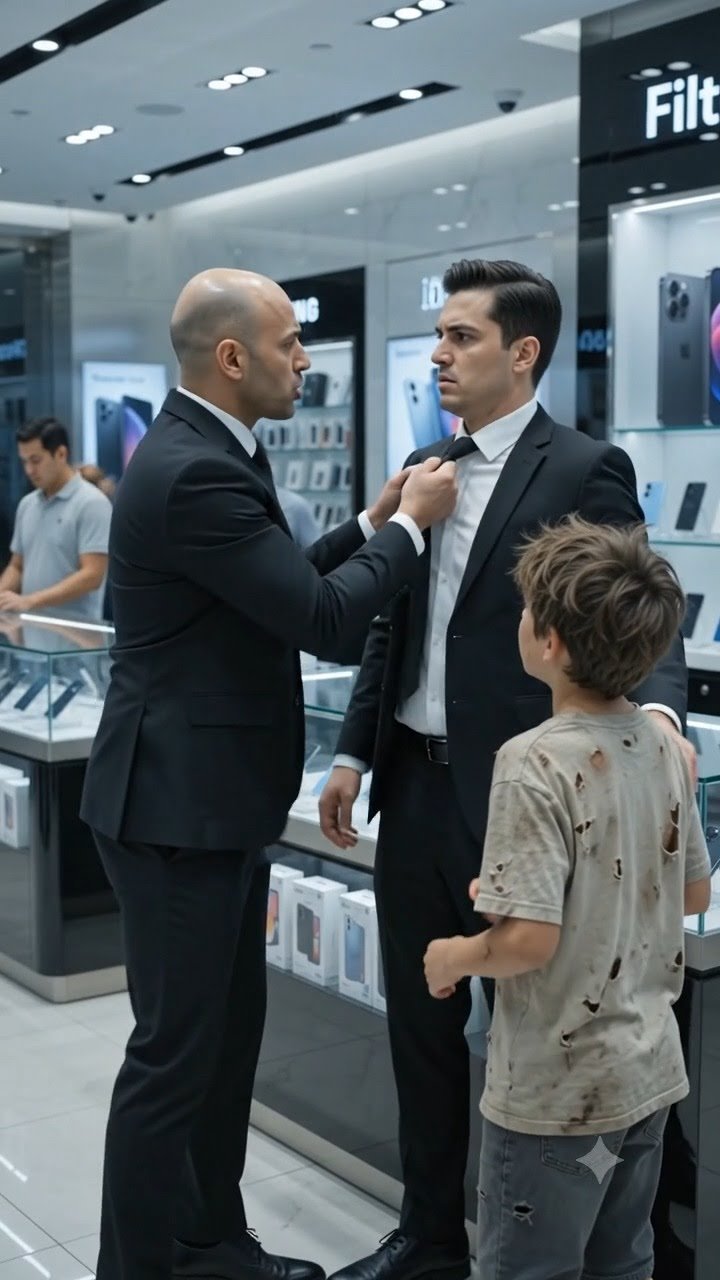
The silence in the showroom didn’t break.
It hardened.
Even the soft hum of the display lights seemed louder now, as if the entire building had become aware of what had just happened.
The clerk stood motionless behind the counter, head lowered, hands trembling slightly at his sides.
He didn’t speak again.
The manager remained beside the boy, still rigid with tension, as though waiting for permission to breathe normally again.
But the boy didn’t look at either of them.
His attention stayed on the shattered phone resting on the glass counter.
The cracks caught the light like a fractured memory.
Boy (softly): “Can it still be repaired today?”
The question cut through the room.
Simple.
Unbothered by everything that had just unfolded.
The manager immediately nodded.
Manager (respectfully): “Yes, sir. We’ll handle it personally.”
He gestured toward the counter technician, who quickly stepped forward.
But the boy didn’t move.
Didn’t react to the sudden shift in treatment.
Didn’t acknowledge the change in tone.
Instead, he gently slid the phone forward.

Careful.
Like it mattered more than anything else in the room.
The clerk finally lifted his eyes.
Not to the manager.
Not to the crowd.
But to the boy.
This time, there was no arrogance left.
Only something heavier.
Clerk (quietly): “I can fix it.”
A pause.
The manager glanced at him sharply, but didn’t interrupt.
The boy studied him for a moment.
Then spoke.
Boy: “Why didn’t you want to before?”
The question landed harder than any punishment.
The clerk swallowed.
His voice cracked.
Clerk: “I thought… it didn’t matter.”
The boy didn’t respond immediately.
Just looked at the broken screen.

Then at the clerk.
Boy (calmly): “Everything matters to someone.”
A few customers nearby shifted uncomfortably.
One quietly stepped back from the counter.
Another lowered their gaze.
The clerk nodded slowly.
Clerk: “I understand.”
The boy pushed the phone forward again.
Boy: “Fix it properly.”
Clerk: “I will.”
The manager exhaled, tension slowly leaving his shoulders.
But the boy wasn’t finished.
He looked up at the clerk one last time.
Boy (firm, steady): “And don’t decide someone’s value before you understand them.”
No anger.
No raised voice.
Just certainty.
The clerk nodded again, deeper this time.
Clerk: “Yes… sir.”
The manager stepped slightly closer, voice lowered.
Manager: “Sir, we’ll ensure this never happens again.”
The boy finally shook his head.
Boy: “It already happened.”
That line hung in the air longer than anything else.
No one had a response.
The clerk carefully picked up the phone and moved toward the repair station, treating it like something fragile not just in hardware, but in meaning.
The showroom slowly resumed movement, but it was different now.
Quieter.
Heavier.
More aware.
The boy remained at the counter for a moment longer, then gently turned away.
As he walked toward the exit, no one stopped him.
Not because they didn’t want to.
But because they understood something important:
He hadn’t come to prove who he was.
He had come to show them who they were.
Our Facebook Group
Join Our Group