The Handler They Should Never Have Doubted
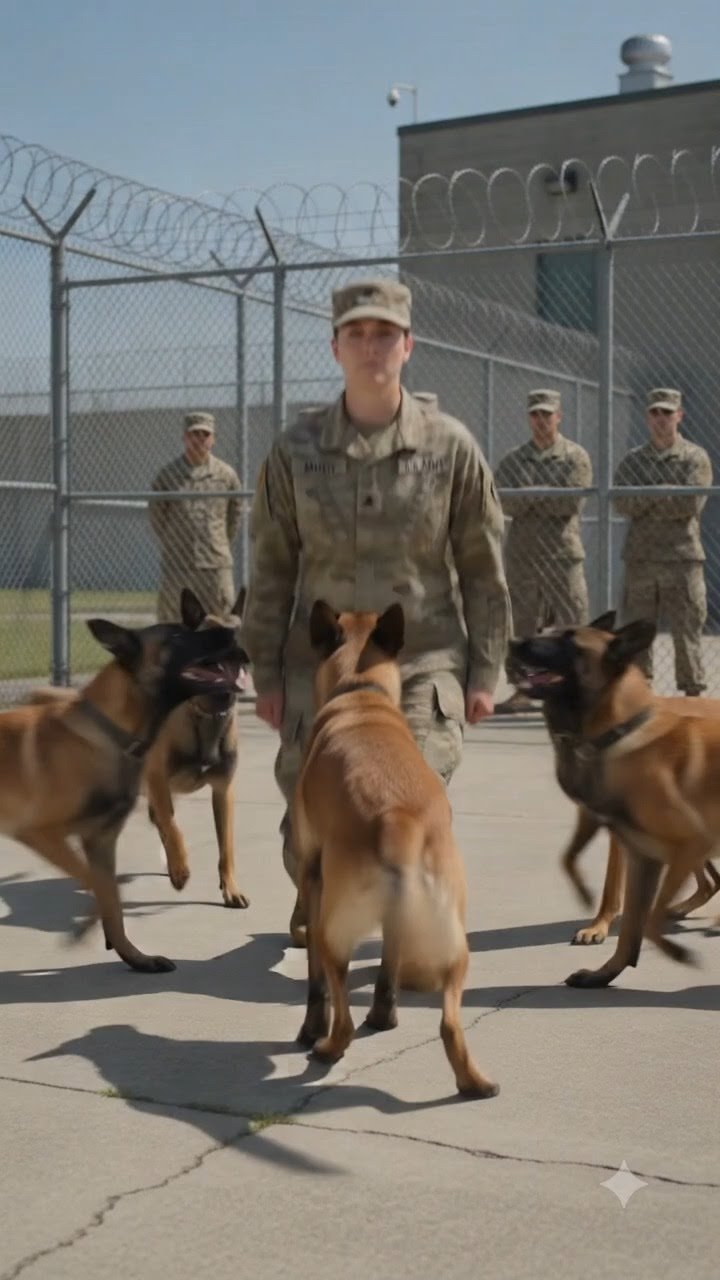
The compound stayed silent.
Not the normal kind of military silence—
but the kind that feels heavier than noise.
The officer behind the fence didn’t speak.
He just stared.
At the four Belgian Malinois sitting in perfect formation.
At the woman standing calmly in front of them.
At something he clearly did not expect to see.
Trust.
The dogs didn’t bark anymore.
Didn’t pace.
Didn’t search for command.
They waited.
As if her presence alone was enough.
The officer finally broke his silence.
Officer (coldly): “That’s not how K9 units operate.”
The woman didn’t react immediately.
She simply looked at the dogs.
Then at him.
Female Soldier (calm): “That’s exactly why yours keep failing.”

A ripple of discomfort moved through the observing soldiers.
The officer’s jaw tightened.
Officer: “These dogs are trained for aggression response.”
The woman slowly knelt again.
One of the Malinois immediately moved closer.
Not aggressively.
Protectively.
Like it was checking if she was still there.
She placed a hand on its neck.
Her fingers moved gently along its collar.
Female Soldier: “They don’t need more aggression.”
She looked up.
Her voice stayed steady.
Female Soldier: “They need clarity.”
A pause.
The wind swept across the training yard.
Dust lifted off the cracked concrete.
One of the younger soldiers behind the fence whispered to another:
Soldier (quietly): “Why are they acting like that with her…?”
No one answered.

Because no one had seen it before.
Not like this.
The officer stepped forward.
Closer to the fence.
Officer (sharply): “Explain yourself.”
The woman rose again.
The dogs mirrored her movement instantly.
Perfect synchronization.
Four bodies.
One instinct.
She turned slightly toward the officer.
Female Soldier: “Because they recognize something your training never taught them to see.”
The officer frowned.
Officer: “And what’s that?”
She paused.
Then answered without hesitation.
Female Soldier: “Safety.”
Silence dropped like a weight.
The Malinois closest to her suddenly sat lower.
Relaxed.
Ears forward.
Breathing steady.
Not waiting for command—
waiting for her mood.
The officer noticed it.
That was the moment his expression changed.
Not anger anymore.
Uncertainty.
Because elite military dogs don’t behave like that unless—
they’ve bonded beyond instruction.
He stepped closer to the fence.
Officer (lower voice): “What unit were you with before this?”
The woman hesitated.
Just for a fraction of a second.
Then she answered.
Female Soldier: “I wasn’t always on your roster.”
The officer’s eyes narrowed.
Female Soldier (continuing): “I worked with dogs that never came back from missions.”
A silence followed that sentence.
He understood what she meant.
Not officially.
But enough.
The Malinois suddenly stood again.
Alert.
Not aggressive.
Protective.
All four of them shifted subtly closer to her.
As if they remembered something too.
Something the base had tried to forget.
The officer looked at the dogs.
Then at her.
Then finally spoke again—this time quieter.
Officer: “Why do they trust you?”
The woman placed both hands gently on the head of the nearest dog.
Her voice softened slightly.
Female Soldier: “Because I never trained them to obey me.”
She looked up.
Eye contact locked.
Female Soldier: “I trained myself to understand them.”
A long pause.
No one moved.
Then one of the Malinois let out a soft exhale and leaned into her leg.
The sound echoed louder than any bark had before.
And for the first time—
the officer realized the evaluation was no longer about her ability to control the dogs.
It was about whether the system itself had been controlling them wrong all along.
Our Facebook Group
Join Our Group