PART 2: The Pendant That Awakened Rome’s Forgotten Power
The silence did not arrive gently.
It snapped into the arena like a breaking chain.
One moment, senators were laughing from the high marble balconies, their voices echoing with arrogance across the stone walls.
The next—
Nothing.
Even the wind seemed to hesitate.
The boy stood alone in the center of the arena, his feet half-buried in the dry sand. The rusted iron sword on the stone pedestal beside him looked heavier than anything in the world, not because of its metal—but because of what it represented.
Judgment.
Legacy.
Endings.
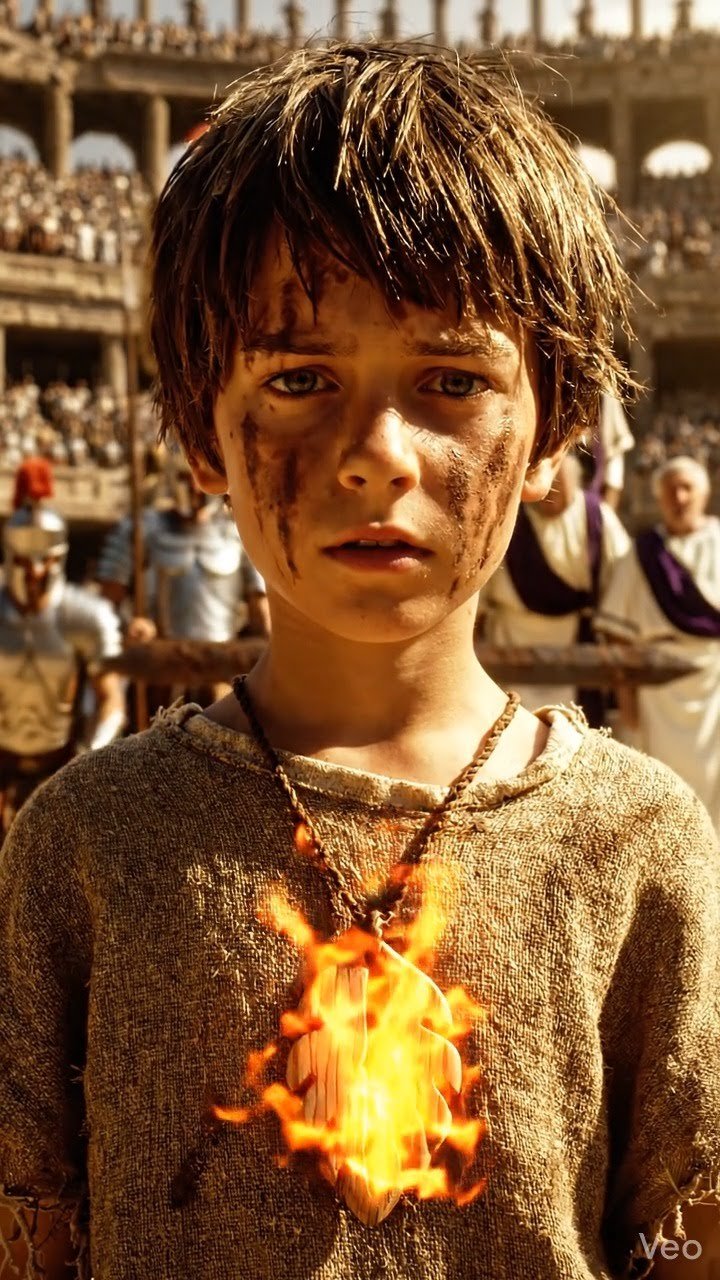
His wooden pendant pulsed again.
Louder.
Warmer.
The faint orange glow spread across his chest, casting shifting light onto his torn tunic. The patterns carved into the wood—once invisible—now appeared like ancient writing awakening from sleep.
In the stands, a senator leaned forward slowly, his smile fading.
Senator (uneasy): “What is that… artifact?”
No one answered him.
Because no one understood it anymore.
A legionary near the arena gate tightened his grip on his spear. Then another. Then another. Armor clinked softly as tension rippled through the formation behind the boy.
The boy himself did not move.

But his breathing changed.
Deeper.
Heavier.
As if something inside him was responding to the pendant’s call.
The camera moved closer to his face.
The dust on his cheeks no longer looked like dirt.
It looked like history.
Buried.
Waiting.
A voice from the upper balcony tried to restore control.
Roman Official (commanding): “This is nonsense! Proceed with the trial!”
But even his voice lacked conviction.
Because the air itself had changed.
The sunlight above the arena intensified, shifting from ordinary gold to something sharper—almost divine. Shadows around the stone walls deepened unnaturally, as if the world was rebalancing itself around the boy at its center.
The boy finally lifted his gaze toward the pedestal.
The rusted iron sword.
It had been there for centuries, untouched, said to belong to a forgotten general who once defied Rome itself.
No one had ever drawn it.
Not once.
The boy took a step forward.

Then another.
Each step sent faint ripples through the sand, as if the ground recognized him before the crowd did.
Whispers returned—but not mocking now.
Afraid.
Senator (lower voice): “Stop him…”
But no one moved to intervene.
Even the soldiers hesitated.
The pendant’s glow intensified again.
CRACK—
A sudden pulse of energy spread outward from the boy’s chest.
Not destructive.
Awakening.
The arena responded instantly.
Old carvings hidden in the stone walls—covered for centuries—began to glow faintly beneath layers of dust. Symbols of forgotten Rome. Pre-empire markings. Things never meant to be seen again.
The boy stopped in front of the sword.
For the first time, his hand trembled slightly.
Not from fear.
From recognition.
As if he had been here before.
The crowd held its breath.
The pendant flared one final time—
And the rusted iron sword vibrated.
Just once.
A deep metallic hum echoed through the arena floor, spreading like a heartbeat through stone.
Somewhere in the stands, a senator stood up abruptly.
Senator (shaken): “That sword… it’s responding—”
He couldn’t finish.
Because the boy placed his hand on the hilt.
And at that exact moment—
Rome itself seemed to remember something it had tried to forget.
The arena did not erupt.
It awakened.
Slowly.
Deeply.
Irreversibly.
And the boy, standing alone in the center of it all, was no longer just a participant in a trial.
He was the key to something buried beneath centuries of empire.
Our Facebook Group
Join Our Group