PART 2: The Table That Didn’t Turn Away
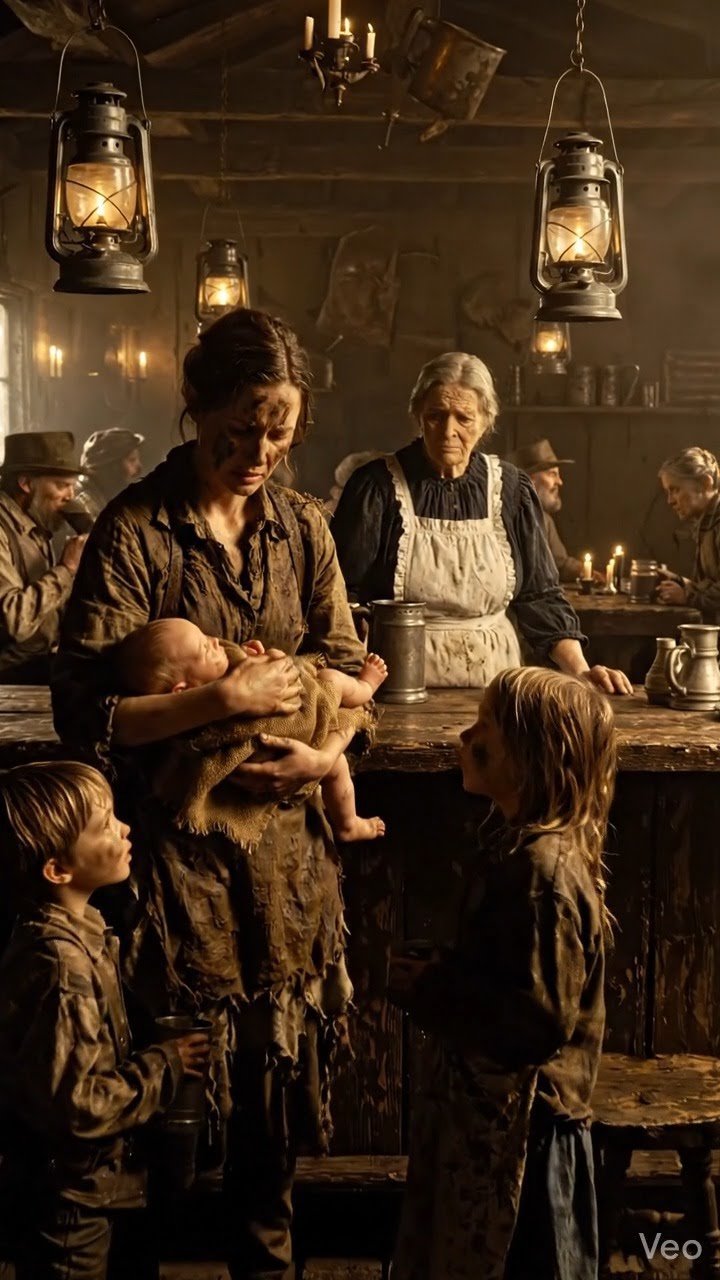
The old woman behind the counter didn’t move at first.
Her eyes stayed on the coins, then drifted back to the children again—slowly, like she was weighing something heavier than money.
The tavern remained unusually quiet.
Not silent.
Just… softened.
Like even the roughest voices inside had lost their edge for a moment.
The mother stood still at the counter, one arm locked around the baby, the other instinctively shielding the two children beside her. Her fingers trembled against the worn fabric of her clothes, but she didn’t step back.
She was used to being measured like this.
Judged.
Waited on.
The old woman finally exhaled through her nose.
A tired sound.
Old Woman: “That’s not enough for a full meal.”
The mother flinched slightly, but nodded immediately.
“I know,” she whispered. “Just… whatever it gets them.”
A pause.
The old woman’s gaze shifted again—this time lingering on the baby wrapped tightly in burlap cloth. Still. Too still.
Then to the children’s hollow faces.
Then back to the mother, who looked like she had been carrying this weight for far too long without letting it fall.
Something in the old woman’s expression changed.
Not sympathy exactly.
Recognition.
She turned slightly, calling over her shoulder without raising her voice.
Old Woman: “Two bowls. Thick stew. Bread. And milk.”
A worker near the back stopped mid-motion.
“Ma’am?” he asked, unsure.
The old woman didn’t look at him.
“I said bring it.”
The tavern shifted subtly.
A few heads turned.
Someone at a nearby table muttered something under their breath, but no one challenged it.
Not this time.
The mother blinked, almost as if she hadn’t heard correctly.
“I… I don’t have—”
The old woman cut her off with a small wave of her hand.
Old Woman: “I didn’t ask what you have.”
A beat.
Then quieter, almost grudgingly—
Old Woman: “Sit.”
The mother hesitated.

Just a second too long.
As if sitting might mean accepting something she wasn’t allowed to accept.
Then the boy tugged her sleeve again.
Softly.
Hungry.
That was enough.
She nodded once.
Slowly, she moved away from the counter and toward a small empty table near the hearth. The children followed closely, like shadows afraid of being left behind.
She lowered herself into the chair, still holding the baby tightly against her chest.
Only now did her shoulders drop slightly.
Just a fraction.
But enough to notice.
Around them, the tavern resumed its sound—but differently now. Less sharp. Less invasive.
Moments later, a wooden tray was placed on the table.
Steaming bowls.
Fresh bread.
A small cup of milk.
The boy stared at it like it might disappear if he blinked.
The mother didn’t reach for it immediately.
Instead, she looked at the old woman behind the counter.
Confused.
Guarded.
Almost afraid kindness had conditions attached.
The old woman wiped her hands on her apron and spoke without turning around.
Old Woman: “Eat first. Questions later.”
A pause.
Then, quieter—
“Kids don’t survive pride out here.”
The mother lowered her gaze.
Something cracked behind her eyes—but she held it in.
Slowly, she tore a piece of bread and handed it to the boy.
Then another to the second child.
Only after they began eating did she finally look down at the baby in her arms.
Still wrapped.
Still fragile.
Her fingers loosened slightly around the cloth.
For the first time in a long while, her voice didn’t tremble as much.
Mother: “…thank you.”
The old woman didn’t answer.
But she didn’t take it back either.
And in a tavern full of tired strangers—
no one laughed.
No one complained.
Because everyone there understood something without saying it:
Sometimes survival doesn’t begin with saving a life.
It begins with not looking away.
Our Facebook Group
Join Our Group