PART 2: THE DAY A SMALL CONFESSION TAUGHT A STATION SOMETHING BIGGER THAN LAW
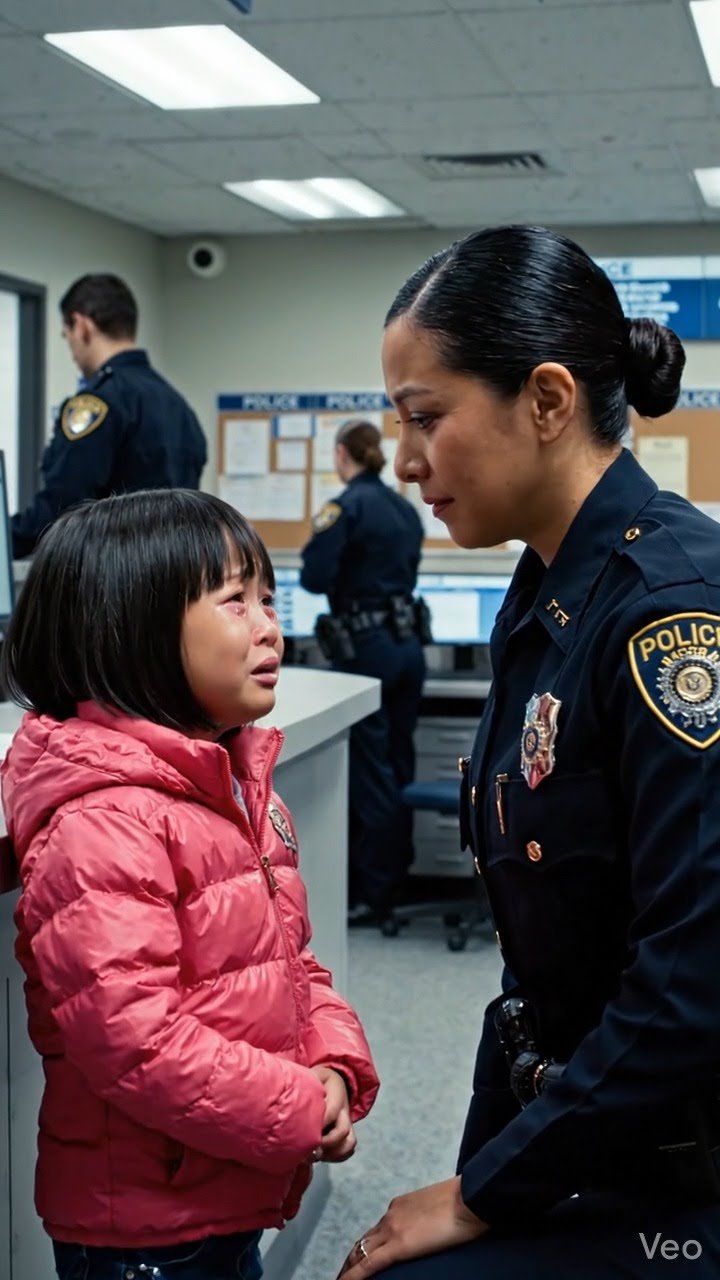
The words didn’t just reach the girl.
They reached the room.
Something softened across the station—shoulders dropped, tension eased, conversations never fully resumed the same way.
The girl blinked up at the officer, unsure.
“…I’m not going to jail?” she asked, her voice still small, still cautious.
The officer shook his head, a gentle smile settling in.
“No,” he said. “Not today. Not for cake.”
A faint ripple of quiet laughter passed through the nearby desks—quickly hidden, but not gone.
The girl looked down at her hands.
“But I lied,” she added, like that part still mattered most.
The officer nodded slowly.
“Yeah,” he said. “That part matters.”
Her eyes lifted again.
“So… what happens now?”
The question hung there—simple, but honest.
The officer thought for a second, then glanced back toward the others.
A few officers were watching now, pretending not to.
He stood up slowly, then reached for something on the front desk—a blank notepad and a pen.
When he knelt back down, he held them out to her.
“We write a report,” he said, his tone just serious enough to feel real.
 The Debt That Set Them Free
Her eyes widened slightly.
“A report?”
“Mm-hmm,” he nodded. “Every important situation needs one.”
She hesitated… then took the pen.
Her small fingers wrapped around it awkwardly.
“What do I write?” she asked.
The officer leaned in just a little.
“The truth,” he said.
She stared at the paper.
Then, slowly—carefully—she began to write.
The letters weren’t neat.
Some were backward.
Some didn’t quite fit on the line.
But she kept going.
“I… ate… the… cake…”
She paused, biting her lip.
“…and I lied.”
When she finished, she looked up at him.
Like she was waiting for judgment.
The officer read it quietly.
 The Fall That Changed Everything
Then nodded once.
“Good report,” he said.
Her shoulders eased—just a little.
“But reports don’t fix everything,” he added gently.
She frowned.
“They don’t?”
He shook his head.
“No. They just tell us what happened.”
A pause.
“Fixing it… that’s the next part.”
The girl looked at the paper again.
Then back at him.
“…Do I have to tell my mom?”
The officer smiled softly.
“Yeah,” he said. “That’s the brave part.”
She swallowed hard.
“That’s harder than jail,” she admitted.
That made a few officers nearby turn away, hiding smiles behind their hands.
The officer chuckled quietly.
“Sometimes it is,” he said. “But it works better.”
The girl looked down again, thinking.
Then slowly nodded.
“Okay.”
She handed the paper back to him.
He took it, folded it carefully, and gave it back.
“This is your copy,” he said. “Proof you told the truth.”
She held it like it mattered.
Because now—it did.
The officer stood, offering his hand.
“Want me to walk you outside?” he asked.
She nodded.
He led her toward the door, the station watching in quiet respect now—not for something dramatic, but for something simple done right.
At the threshold, she stopped.
Turned back slightly.
“Thank you… officer,” she said.
He gave a small nod.
“Anytime.”
She stepped out into the daylight, clutching her report, heading toward something that felt bigger than fear.
Behind her, the station slowly returned to its rhythm.
Phones rang.
Chairs moved.
Voices picked up again.
But something stayed.
A reminder.
That not every confession needs punishment.
And not every mistake needs a siren.
Sometimes—
It just needs someone who knows how to turn fear into honesty…
And honesty into something you can carry home.